Highest-Paying Remote Jobs You Can Start This Month
Real remote roles, honest salary ranges, and what actually gets you hired for each — no vague listicle numbers, no fake job titles. Find the right one for your background and start applying today. Updated for 2026
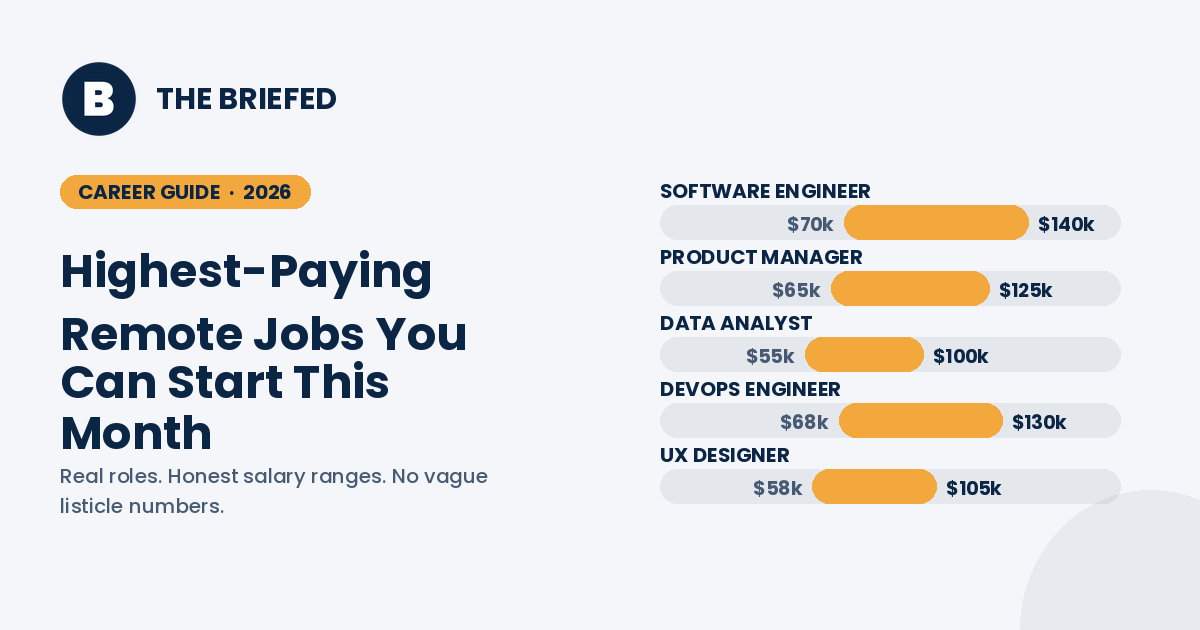
If you've searched "highest paying remote jobs" before, you've probably hit the same wall: listicles that name a job title, throw out a huge salary number with no source, and never tell you how someone with your actual background would land one. This isn't that. Below are roles that are genuinely, consistently remote-friendly, with realistic salary ranges and what actually gets you hired for each — not the ceiling number a handful of outliers report.
One honest note before we start: "highest-paying" and "easiest to get" are usually opposites. The roles below are ordered roughly by how attainable they are without years of niche experience, not by salary alone — because a job you can't actually get isn't worth reading about.
Quick overview
| RoleTypical remote salary range (USD/year)Entry barrier | ||
| Software / Web Developer | $50,000 – $130,000 | Medium |
| DevOps / Cloud Engineer | $70,000 – $150,000 | Medium-High |
| Data Analyst | $55,000 – $95,000 | Medium |
| UX/UI Designer | $55,000 – $110,000 | Medium |
| Product Manager | $75,000 – $140,000 | High |
| Digital Marketing Manager | $50,000 – $100,000 | Medium |
| Cybersecurity Analyst | $65,000 – $120,000 | Medium-High |
| Technical Content Writer | $40,000 – $85,000 | Low-Medium |
| Customer Success Manager | $45,000 – $85,000 | Low-Medium |
| Virtual Executive Assistant | $30,000 – $60,000 | Low |
Ranges vary significantly by employer location, your experience level, and whether the company pays on a global or US/EU-anchored salary band — a company paying US-based salaries to a remote hire anywhere in the world sits at the high end; one adjusting pay to your local cost of living sits lower.
Software & Web Developer
Still the single most reliably remote-first career path that exists. Companies have hired developers remotely for over a decade — this isn't a pandemic-era trend that's fading, it's the default for most software teams now.
What actually gets you hired
A portfolio of real, working projects (not tutorials you followed) matters more than a degree. Pick one stack — commonly JavaScript/TypeScript with React or Node, or Python — and go deep rather than sampling five frameworks shallowly. Contribute to one open-source project if you can; it's a stronger signal than another personal project.
DevOps / Cloud Engineer
Higher ceiling than plain development, because there are fewer people who actually know infrastructure well. If you already have a couple of years as a developer or sysadmin, this is often the highest-leverage skill to add.
What actually gets you hired
A certification (AWS, Azure, or GCP) plus a demonstrable project — even a personal one — showing you can set up CI/CD, containerize an app, and manage it in the cloud. Interviewers care more about "can you explain what you built and why" than the cert itself.
Data Analyst
Lower barrier to entry than "Data Scientist" (which usually wants a stats/ML background), but still well-paid and in steady demand — every company with a product now wants someone reading its numbers.
What actually gets you hired
SQL, genuinely well — not "I know the syntax" but "I can write a multi-join query to answer a real business question." Pair it with either Excel/Google Sheets at an advanced level or a BI tool (Power BI, Tableau, Looker). A couple of public dashboards using real (public) datasets go a long way in an application.
UX/UI Designer
Remote-friendly because the deliverable — a design file — travels perfectly over the internet. Competitive, but there's real room if your portfolio shows process, not just pretty screens.
What actually gets you hired
3-4 case studies that show the problem you were solving and your reasoning, not just final mockups. Employers can tell within 30 seconds whether a portfolio is "made pretty things" or "solved a real problem" — the second gets interviews.
Product Manager
The highest ceiling on this list, but genuinely the hardest to break into without prior experience — most PM roles want to see you've shipped something, even informally.
What actually gets you hired
A track record of making decisions with incomplete information and explaining trade-offs — this can come from running a small project, a startup side-project, or even leading initiatives in a non-PM role. "I decided X over Y because of Z" is the sentence structure hiring managers are listening for.
Digital Marketing Manager
Consistently remote because marketing work is almost entirely digital by nature. Broad title covering SEO, paid ads, and content strategy — specializing in one usually pays better than being a generalist.
What actually gets you hired
Results you can point to — traffic growth, campaign ROI, conversion rate improvements — with actual numbers, even from a small business or personal project. "I grew X by Y%" beats any certification.
Cybersecurity Analyst
Genuinely under-supplied relative to demand, which keeps pay strong. Companies increasingly accept remote security hires because the work is monitoring/analysis-based, not physical.
What actually gets you hired
Security+ or a similar foundational cert, plus hands-on practice — platforms like TryHackMe or a home lab you can talk through in an interview. Employers want to see you've actually broken and fixed things, not just read about it.
Technical Content Writer
Lower salary ceiling than the roles above, but genuinely one of the easiest to start immediately with no formal credentials — and a realistic stepping stone into marketing or product roles later.
What actually gets you hired
Writing samples in the specific niche you're targeting (SaaS, developer docs, finance) matter far more than a journalism degree. Three strong, published-quality samples beat a portfolio of ten mediocre ones.
Customer Success Manager
Steady demand from every subscription-based company, and increasingly remote since the job is relationship management over calls and email, not in-person.
What actually gets you hired
Any prior customer-facing experience (support, sales, account management) reframed around retention and problem-solving, not just "handled tickets."
Virtual Executive Assistant
The lowest barrier to entry on this list and genuinely remote by design — but treat the low-end range with caution, since this category also attracts the most scam postings (see the warning below).
What actually gets you hired
Organization skills you can demonstrate concretely — calendar/inbox management, tool fluency (Notion, Slack, project management software), and reliability signals like on-time delivery on any past freelance work.
A quick warning
The lower-barrier roles on this list — virtual assistant, entry-level content writing, data entry-adjacent work — are also the most heavily targeted by fake job postings. If a "remote job" asks you to pay for training, equipment, or a background check before you're hired, or the pay sounds too high for the effort described, walk away. Legitimate employers never ask a candidate to pay them.
Frequently asked questions
Do I need a degree for these jobs?
For most of them — no. Development, design, marketing, and cybersecurity are increasingly portfolio- and skill-first fields. Product management is the exception where prior experience (of some kind) matters more than credentials.
Is remote pay really lower than office pay?
It depends entirely on the employer. Some companies pay a single global rate regardless of where you live; others adjust pay to your local cost of living. Ask directly during the interview process — it's a completely normal question.
How long does it realistically take to land a remote job in one of these fields?
If you're starting from zero in a technical field (development, DevOps, cybersecurity), 4-8 months of focused learning plus a portfolio is realistic before you're competitive. For writing, marketing, or customer success, it can be weeks if you already have transferable experience to reframe.
Ready to put this into action? Browse remote roles hiring right now, or if your resume needs work first, build a free, ATS-friendly resume.
Comments · 0