Freelance vs Full-Time Remote: Which Pays more in 2026?
Most income comparisons between freelancing and full-time remote work get it wrong — not because the numbers are made up, but because they compare the wrong things. Here's what the two actually look like side by side, after benefits, unpaid hours, and income gaps are factored in.
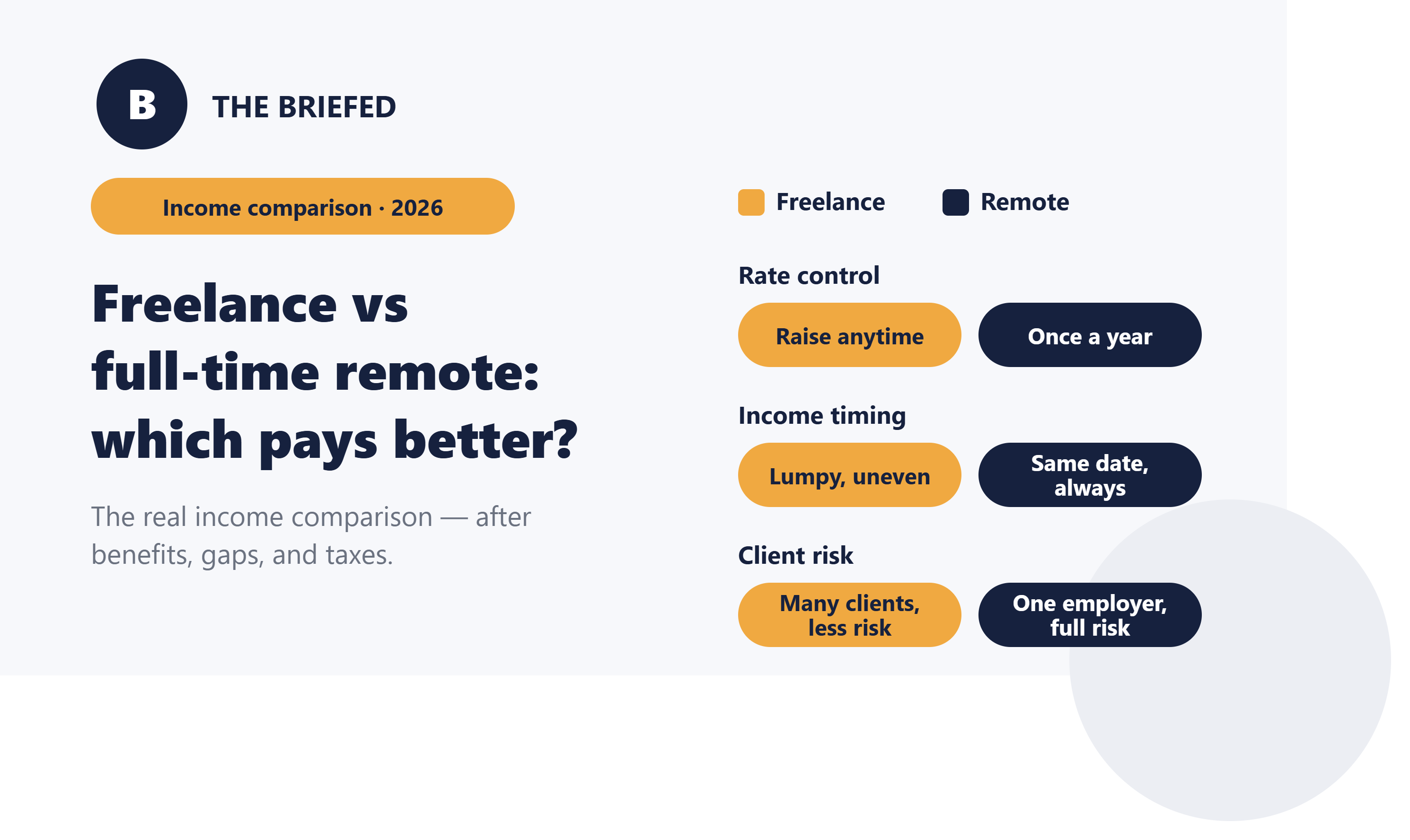
The honest answer is that "freelancing pays more" and "full-time is safer" are both half-true. Neither one tells you what actually matters: what you take home after gaps, taxes, and benefits you'd otherwise get for free are factored in. The gap between the two is usually smaller than people expect — and the decision almost always comes down to something other than the raw numbers.
On paper, freelance rates look bigger — here's why that's misleading
Freelancers typically charge 1.5 to 2 times what an equivalent salaried hourly rate works out to. That's not greed — it's math. A freelance rate has to cover the time you're not billing: writing proposals, chasing invoices, the week between clients where nothing's coming in. A $50/hour freelance rate is a completely different thing from a $50/hour salary.
The number most freelancers forget to subtract is unbillable hours. Even experienced freelancers realistically bill 60–75% of their working time. Run that through a $50/hour rate and you're closer to $35/hour in real terms. Still competitive in many cases — but not the number on your invoice, and not what you should be comparing to a salary.
What a full-time remote role actually gives you (that isn't in the salary figure)
Health insurance, pension contributions, paid leave, and employer payroll taxes typically add 20–30% on top of salary in real value — money a freelancer has to buy or set aside themselves. Most people don't price that in when they're comparing offers.
There's also the simpler thing: a salary arrives on the same date every month regardless of how business is going. Freelance income is lumpy by nature. Some months are excellent. Some are thin. If you're the sole earner in your household or carrying a mortgage, that variability is worth a lot more to think about than most income comparisons acknowledge. If you're going this route, target the highest-paying remote jobs and see what actually gets you hired for each.
What freelancing actually gives you that a salary doesn't
Rate control.
A freelancer can raise their rate for new clients whenever their demand supports it. A salaried employee typically gets one negotiation window a year, if that — and "the market rate" is often used to explain why that window stays closed.
Multiple income streams.
Losing one client is unpleasant. Losing your only employer is a crisis. Several smaller clients are inherently more resilient, which is something the "freelancing is risky" framing often ignores.
Tax deductions.
Home office costs, equipment, software, and part of your internet and utilities are often deductible as business expenses when you're self-employed — in ways a salaried employee's costs usually aren't. Depending on your situation, this can meaningfully reduce your actual tax bill.
How to actually decide
Run your own numbers, not someone else's.
Take the full-time offer's salary, add 25% for benefits, and compare that to your realistic freelance rate at 70% utilization minus the overhead. Whichever is genuinely higher — not the more exciting one — is your income answer.
Be honest about your financial cushion.
If you have three or more months of expenses saved and can absorb uneven income, freelancing's ceiling is worth going after. If you're supporting others or have little buffer, the predictability of a full-time role is worth more than any freelance upside on a spreadsheet.
Consider the hybrid path before committing to either.
A lot of people take a full-time remote role while building freelance clients on the side, then move fully independent once the freelance income reliably covers their needs. It's lower risk than jumping in cold and smarter than dismissing freelancing entirely.
A worked example that makes the comparison real
Say you have a full-time remote offer at $70,000 a year. Add roughly 25% for the value of benefits — health cover, pension, leave — and the total value is around $87,500.
Now run the freelance equivalent: $60/hour, billing 70% of a 40-hour week. That's roughly $87,000 a year before taxes and before subtracting the extra hours you'll spend on invoicing, proposals, and client-finding.
On paper, they're almost identical. Which is exactly why this decision usually comes down to how much stability you need and what kind of work life you actually want — not which number is technically larger.
What changes once you actually start
The freelance ramp-up takes longer than people expect.
The first six to twelve months are the hardest — before a repeat-client base builds and before you stop spending 30% of your time finding the next thing. Budget for this ramp-up rather than projecting freelance-level income from week one.
Full-time remote doesn't automatically solve for everything either.
Some people find the stability comes with less flexibility than they expected — and miss the autonomy even while valuing the steady paycheck. The trade-off runs both ways.
Compare real full-time remote salaries on The Briefed's remote jobs page, or get your resume ready with our free resume builder.
Comments · 0