STAR Interview Method: How to Answer With Examples
The STAR interview method is a way to answer behavioral questions in four parts: Situation, Task, Action and Result. Learn how long each step should take, see sample answers for a deadline, a disagreement and a team project, and find out how STAR compares with STARR, CAR and SOAR.
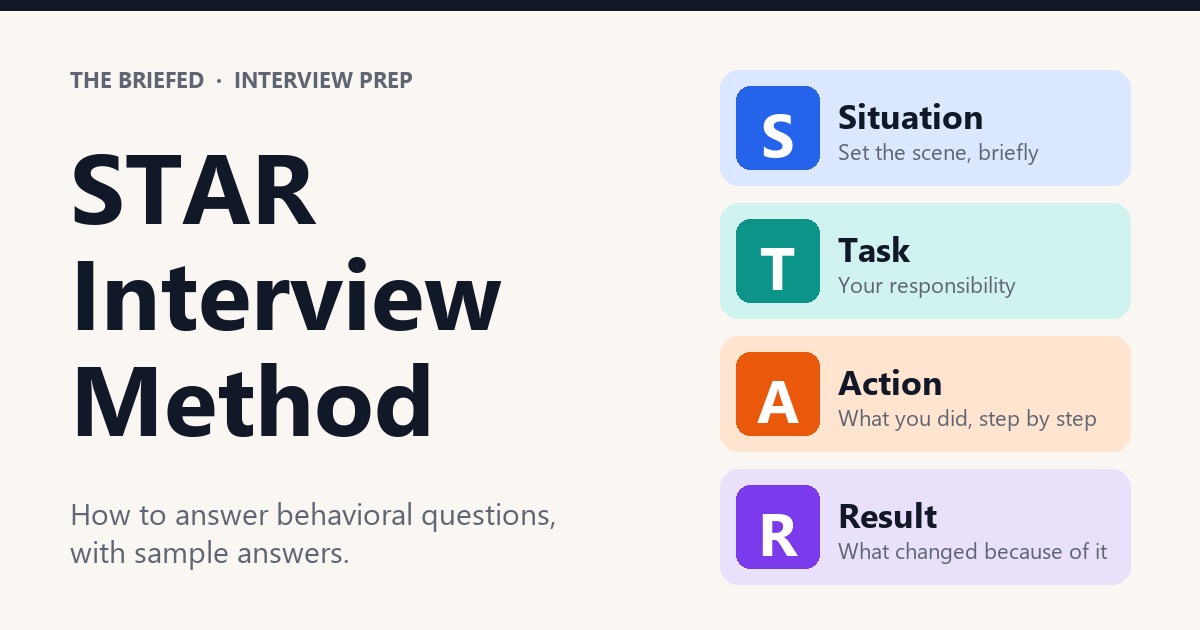
The STAR interview method is a way of answering behavioral questions in four parts: Situation, Task, Action and Result. It’s what you reach for when an interviewer says “tell me about a time when…” and you need to tell a real story without losing the thread. This guide covers the four steps, sample answers (including one for freshers), and how STAR compares with STARR, CAR and SOAR.
You probably remember what happened. The trouble is the order. It’s natural to start where the story started, spend a minute and a half on background, and only reach your own part when the interviewer is already writing down the next question. STAR just forces you to get to the point.
Why do interviewers ask behavioral questions?
A CV says what you did. It doesn’t say how you went about it, and that’s what a behavioral question is for. “I’d talk to the team first” is a perfectly good answer to a hypothetical, and anyone can say it. A real story can be followed up on. Say you describe a disagreement with a manager: what did you actually say to them? Were they surprised? What would you change? If you lived it, those questions are easy. If you made it up, they aren’t.
When to use the STAR method
The obvious cues are “Tell me about a time when…”, “Give me an example of…”, “Describe a situation where…” and “Have you ever had to…”.
The less obvious ones catch people out. “How do you handle pressure?” sounds like a request to describe your personality, but it’s really asking for a story. Pick one time you were under pressure and tell that. A story is far more convincing than “I stay calm.”
Some questions aren’t STAR questions at all. “Tell me about yourself” wants a short summary of where you are now and what you’re after. We’ve covered it, along with 24 others, in 25 job interview questions with sample answers. If you’re interviewing in Pakistan, common job interview questions asked in Pakistan is worth a read too.
The 4 steps of the STAR interview method
Aim for 90 seconds to two minutes, which is around 200 to 250 words if you wrote it down. Most of that should be Action.
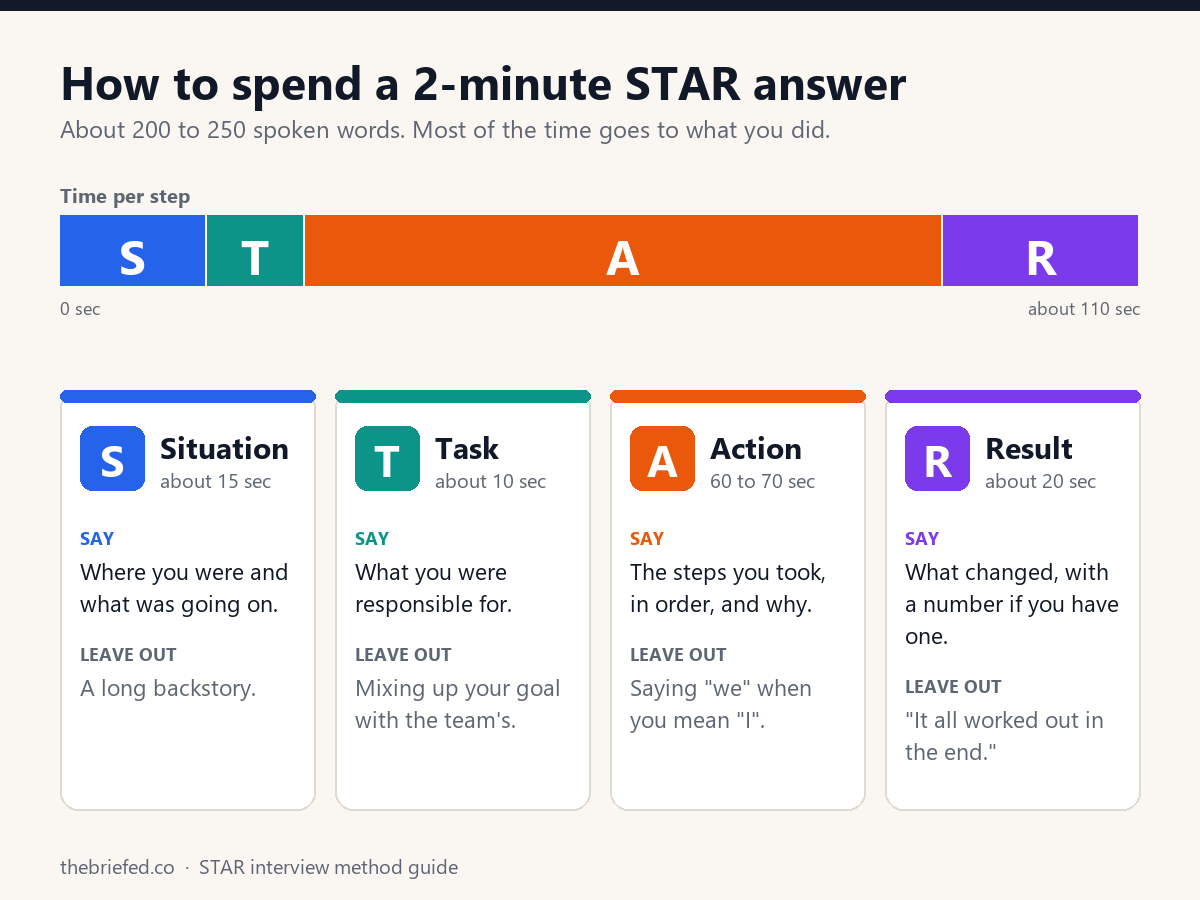
- Situation (about 15 sec): Say where you were and what was going on. Leave out a long backstory.
- Task (about 10 sec): Say what you were responsible for. Leave out your team’s goal when yours was different.
- Action (60 to 70 sec): Say the steps you took, in order, and why. Don’t say “we” when you mean “I”.
- Result (about 20 sec): Say what changed, with a number if you have one. Don’t say “It all worked out in the end”.
Situation. Set the scene in a sentence or two. “Month-end close was due on Monday and my manager was out sick” does the job. You don’t need the company’s history.
Task. What was yours to do. It’s tempting to skip this and run the Situation straight into the Action, and some career offices teach it that way (the University of Wisconsin–Madison’s guide folds the two together). We’d still say it out loud. It’s where you tell the interviewer what you were responsible for, and that gets blurry fast when there’s a team involved.
Action. This is what they’re listening for, so give it room. Say what you did, in the order you did it, and why you picked that route when another one was available. Use “I”. Say “we” when the team did something, sure, but if the interviewer can’t tell which bits were yours, they’ve learned nothing about you. And describe, don’t summarize. “I managed the situation” tells them nothing.
Result. What changed. A number helps if you have one: hours saved, errors found, a mark, a customer who stayed. If you don’t, say what people did or said afterwards. If it went badly, add one sentence on what you’d do differently, then stop. You don’t need a closing speech.
STAR method interview questions and answers
Here are eight questions worth preparing for, grouped by what the interviewer is really trying to find out. The short answers are sketches in spoken style, and they’re made up, so don’t borrow them word for word.
Teamwork and disagreement
“Tell me about a time you worked in a team” and “Tell me about a time you disagreed with a manager or client.” Both are about whether you’re easy to work with when things get awkward. So skip the project where everyone got along and choose one with a bit of friction. For the disagreement, pick a case where you had facts to back you up, and where you’re still on good terms with the person. Full answers to both appear in the examples below.
Pressure and speed
“Tell me about a time you worked under a tight deadline” and “Tell me about a time you had to learn something quickly.” They want to know you don’t freeze. The deadline question has a full answer below. For the second one, something like: “I was put on a project that used a framework I’d never touched. I did the official tutorial over two evenings, built a tiny throwaway app, and asked a senior colleague to look over my first change. I shipped my first feature the week after.”
Mistakes and difficult people
“Tell me about a time you failed” is the one people dread, and it’s easier than it sounds if you pick a real mistake of ordinary size, like a wrong figure in a report or a missed handover. For example: “I sent a client a report with last month’s figures in it. I noticed an hour later, rang them before they’d opened it, sent the right file, and now I check the dates before anything goes out.”
“Tell me about a time you dealt with a difficult customer or colleague” is mostly checking your temper. A short version: “A customer wanted a refund we couldn’t give under our policy. I let him finish, repeated the problem back to him and, after checking with my manager, offered a replacement and a discount. He took it, and he ordered again the next month.”
Initiative and leadership
“Tell me about a time you took initiative” and “Tell me about a time you led a project or a group.” Neither needs a job title. A student society event counts. For initiative: “We kept answering the same five customer questions all day, so I wrote the answers into a shared document and suggested a saved-reply tool. Replies got quicker, and the document ended up in the onboarding pack.” For leading: “I ran our society’s annual event with nine volunteers and not much money. I split the jobs by who was good at what, wrote down who owned each one, and checked in every Sunday. We finished under budget, and two of the volunteers asked to lead next year.”
STAR method examples: a deadline and a disagreement
Two STAR answers are written out in full below: one about a deadline problem and one about a disagreement with a manager. They’re samples and the figures are invented. Said aloud, they should sound looser than they read here. Take the shape and use your own story.
Sample 1: a problem right before a deadline
- Situation: Month-end close was due Monday at nine, and my manager was out sick. On Friday afternoon the bank reconciliation was off by $8,400.
- Task: I was the junior accountant on the close, so finding it was down to me. The report was going to the CFO and it couldn’t go out with a gap that size.
- Action: I started by ruling out the obvious things: a typo in the opening balance, a missing statement. Neither. Then I sorted both sides by amount and matched them one by one, and found one supplier payment batch that had been posted twice. I checked the bank portal to be sure the money had only left once, reversed the duplicate, and wrote a short note for the file explaining what I’d done. I also messaged my manager so she wouldn’t be surprised on Monday.
- Result: The reconciliation balanced on Saturday morning, the report went out on time, and the finance team added a duplicate-payment check to the close checklist.
Sample 2: a disagreement with a manager
I was an operations coordinator at a courier company, and my manager wanted us to promise next-day delivery to our northern region in the new ads. I thought that was a mistake, because our own figures showed a lot of northern-region parcels arriving on day three. Flagging problems like that was part of my job, so I pulled the last two months of delivery times and put them on one page, with the share of late parcels for each region side by side. Then I suggested we promise two-day delivery to the northern region and keep next-day for the regions where we could back it up. He agreed to try it. Late-delivery complaints from the northern region dropped over the next two months, and the ad went out with the two-day line.
Here is how the disagreement answer maps to STAR. The first two sentences are the situation and the task. “I pulled the last two months of delivery times” is where the action starts, and the last two sentences are the result. You don’t have to announce the labels, but the order should be there.
STAR method example for freshers and interns
If you haven’t had a job yet, you can still use STAR. Interviewers hiring freshers know you haven’t held one, so they expect stories from a final-year or capstone project, a society, volunteering, a part-time job, freelance work or an internship. (If the internship is what you’re hunting for, our internships page is where to look.)
Sample 3: working in a team
In my last semester, four of us were building an attendance app for our software engineering course. Three weeks before the demo, one of the team stopped replying to messages. I was the team lead, so getting the demo working was on me. I messaged him directly and found out he was stuck on the database part and too embarrassed to say so. He’d already built a login screen in an earlier course, so I moved him onto that and took the database work myself over two weekends. We also started a ten-minute call every other evening so nobody could go quiet again. We presented on time, and our supervisor asked us to show the app to the next batch. My teammate told me later that the calls were what got him back on track.
It’s an ordinary project. What makes the answer work is that something went wrong and the you made a decision about it.
STAR vs STARR, CAR and SOAR
STAR isn’t the only acronym going around. The others are small variations.
- STAR (Situation, Task, Action, Result): Use it for most behavioral questions.
- STARR (Situation, Task, Action, Result, Reflection): Use it when your story involves a mistake or a lesson.
- CAR (Context, Action, Result): Use it when you have little time, or you’re writing a CV bullet.
- SOAR (Situation, Obstacle, Action, Result): Use it when the question is about a challenge you overcame.
STARR adds a last step where you say what you learned or what you’d change. Leiden University’s career service teaches it that way, and it fits well when the question is about a mistake. CAR drops the Task and is handy for CV bullets. SOAR swaps the Task for an Obstacle, which suits questions about getting past a problem.
What are common STAR method mistakes?
The most common one is starting too far back. If your Situation is still going after 30 seconds, you’re going to rush the part that matters. Cut it until it’s two sentences.
Then there’s “we”. We built it, we decided, we fixed it. It’s natural, and teams really do work together, but the interviewer is deciding whether to hire you, and a story where you disappear into the group doesn’t help your case.
Another is choosing a story where nothing went wrong. A smooth project is great to work on and awkward to talk about, because there’s no problem to solve and so nothing to describe.
Leaving out the result because you don’t have a number is a quieter mistake. A plain sentence about what changed is fine.
And then there’s memorizing the answer word for word. It sounds recited, and one follow-up question can derail it. Know the outline of each story and say it fresh each time. Improvising from nothing has its own problem: you’ll usually forget to give the result.
How to build a story bank before the interview
You don’t need a story for every question. We’d aim for five or six, because one story can be pointed in different directions depending on what you stress.
- Start with the job listing and underline what it keeps asking for: deadlines, clients, learning fast. If you look at a few listings for the same role on the Briefed jobs board, the repeats stand out.
- Go through your projects, internships and coursework and note the ones where something went wrong, or where you had to make a decision.
- Write four short lines for each story: situation, task, action, result. Bullet points only. Full sentences make you sound like you’re reading.
- Say them out loud with a timer running. Record one on your phone if you can bear it. It’s uncomfortable to listen to, and it’s the quickest way to hear where you ramble. Aim for under two minutes.
- Look at your CV. A line like “cut report time from two days to one” is a story waiting to be asked about. If the CV needs work, the resume builder and the free ATS resume checker can help.
Comments · 0