Behavioral Interview Questions With Answers: 30 Examples
Behavioral questions ask what you did, not what you would do. Thirty common ones with short STAR sample answers, grouped by skill
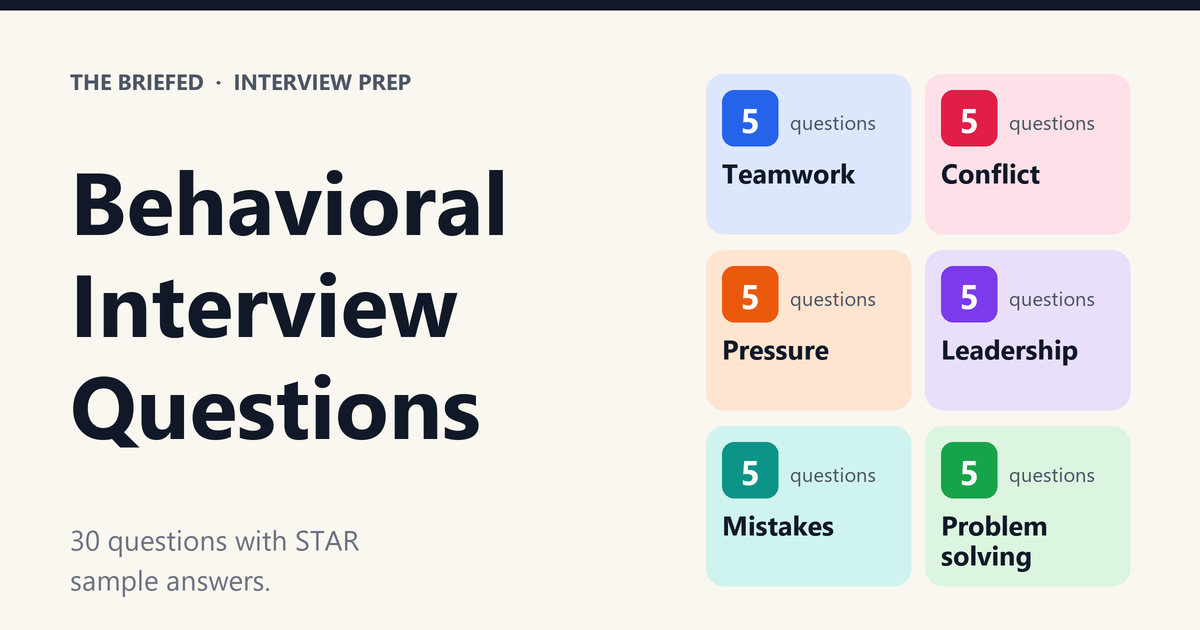
Behavioral interview questions ask you to describe something you actually did, usually starting with "tell me about a time when...” The best way to answer is the STAR method: the Situation, the Task, the Action you took and the Result. Below are 30 common questions grouped by skill, each with a short sample answer you can adapt.
The interviewer's reasoning is simple: how you handled something before is the best guide to how you will handle it here. Your answers need to be real, specific and short. This page gives you the questions, the samples, and a way to prepare six stories that cover most of what you will be asked. For the method itself, our STAR interview method guide goes through each step with timings.
How to answer behavioral interview questions with the STAR method
Each sample below follows the same shape, and you can use it as a template.
- Situation: one or two sentences of background. Where, when, what was going on.
- Task: what you were responsible for.
- Action: what you did. This is the longest part, and it should say "I", not "we".
- Result: what happened, with a number if you have one, and what you learned.
Spend about half your time on the action. People who spend most of it on the situation lose the interviewer before they reach their own part. Behavioral questions are one part of an interview. For the standard ones, see our list of job interview questions and answers.
Prepare six stories, not thirty answers
You do not need to memorise thirty answers. Most behavioral questions can be answered with a small set of stories, because one good story fits several questions. Write down six real moments: a team project, a disagreement, something that went wrong, a deadline, a time you took the lead, and a time you learned something fast. For each, note the situation, your action and the result.
Then, when you hear a question, you choose the story that fits and shape it. If you are a student or fresh graduate, university projects, society work, part-time jobs, internships and family business all count.
The same stories help with the opening question, so build your tell me about yourself answer from them. If you are interviewing in Pakistan, employers also ask about family, salary and relocation, which our guide to interview questions in Pakistan covers.
Teamwork behavioral interview questions
These are samples written for practice. Replace each with your own story and keep only numbers you can explain.
1. Tell me about a time you worked in a team.
In my final year, four of us built a booking app for our software engineering course. I was in charge of the database and the login. When two teammates fell behind, I offered to take the notification feature as well, and we agreed on a shared task list so everyone could see what was open. We finished on time and got the highest mark in the class for the project.
2. Describe a time you helped a teammate who was struggling.
At my internship, another intern was stuck on an Excel report that needed to go to the manager the same afternoon. I had finished my own work, so I sat with them for an hour and showed them how to use pivot tables. The report went out on time, and afterwards the manager asked both of us to prepare the weekly numbers.
3. Tell me about a time you worked with someone very different from you.
I worked on a society event with a teammate who preferred to plan everything weeks ahead, while I liked to start quickly. At first we kept clashing. I suggested that she made the schedule and I handled the day-of tasks. The event went smoothly, and I learned to value planning more.
4. Tell me about a time you were part of a group that did not agree.
Our group could not decide between two topics for a marketing presentation. I asked everyone to give one reason for their choice, and we saw that one option needed data we did not have. We went with the other. It meant dropping an idea I liked, but the presentation was stronger for it.
5. Describe a time you contributed to a team's success without being asked.
At a part-time job in a retail shop, the customer returns were piling up in a corner with no record. Without being asked, I made a simple sheet to log each return, with the date and reason. After two weeks the owner noticed that most returns were one product in one size and changed the supplier.
Conflict behavioral interview questions
6. Tell me about a conflict with a coworker and how you handled it.
A colleague and I kept missing each other's messages and both thought the other was ignoring the work. I asked to talk privately, said what I had noticed without blaming, and asked how he preferred to be contacted. We agreed to a short call each morning. The problem stopped within a week.
7. Describe a time you disagreed with your manager.
My manager wanted to send a promotion email to our entire list. I thought it would annoy customers who had just bought. I brought two examples from past campaigns and suggested sending to a smaller group first. She agreed to test it, and the smaller send got a better response. We then sent it to the rest.
8. Tell me about a time you dealt with a difficult customer.
At a courier company, a customer called three times in one day about a missing parcel. I stayed calm, let him finish and told him exactly what I would do and by when. I found the parcel at the wrong branch, called him back within the hour and arranged delivery for the next morning. He thanked me when it arrived.
9. Describe a time you had to give someone feedback they did not want to hear.
A teammate's slides had many spelling errors, and the presentation was the next day. I told him privately, pointed to two examples and offered to check the rest with him. He was embarrassed at first but we fixed them that evening. He later said he preferred hearing it from me than from the teacher.
10. Tell me about a time you had to work with someone you did not get along with.
At university, I was paired with someone I found difficult to talk to. I decided to keep our communication to the task, wrote down who was doing what, and kept to my deadlines. We were not close, but the project got a good grade, and I learned that I do not need to like someone to work well with them.
Pressure and deadline behavioral interview questions
11. Tell me about a time you worked under pressure.
During exam week, my group project deadline fell two days before my last paper. I made a plan that split the work into daily goals and told the group I would finish my part early. I handed in my section a day ahead, and the project was submitted on time. I also passed the paper.
12. Describe a time you missed a deadline.
I once submitted a report a day late because I underestimated how long the data cleaning would take. I told my supervisor the same morning, shared a partial draft and finished by the next afternoon. Since then I add a buffer day to any task that depends on messy data.
13. How do you prioritize when everything seems urgent?
During Eid sale week at the shop where I worked, orders, returns and phone queries all arrived at once. I wrote a list and sorted it by what had a customer waiting and a time limit. Delivery orders went first, then queries, then returns. We cleared the backlog by evening, and I used the same method after that.
14. Tell me about a time you had to learn something quickly.
My manager asked me to produce a report in Power BI the week I joined, and I had never used it. I watched two tutorials that evening and rebuilt one of the existing reports as practice. The first version I showed had two errors, which my colleague pointed out. By the end of the week I was producing the report alone.
15. Describe a time you handled several tasks at once.
In my last semester I was doing a part-time job, a final year project and a society role. I used a weekly calendar with fixed hours for each and told my project supervisor which days I would not be available. I met every deadline except one small society task, which I handed over to a friend.
Initiative and leadership behavioral interview questions
Questions about initiative often lead into why should we hire you, because both ask what you would bring to the job.
16. Tell me about a time you took the lead.
Our society's annual event had no organizer two weeks before the date. I volunteered, split the work into five teams and held a ten-minute check-in each evening. About 200 people attended. I learned that leading mostly means making sure everyone knows what they are doing.
17. Describe a time you showed initiative.
At my internship I noticed that we answered the same five questions from customers on WhatsApp every day. I wrote short saved replies for them and shared them with the team. The average reply time went down, and my supervisor asked me to write replies for another product.
18. Tell me about a time you motivated others.
My group was losing energy on a long project. I suggested splitting the remaining work into small weekly goals and giving ourselves a short break after each. People began finishing early. We submitted two days before the deadline.
19. Describe a time you set a goal and reached it.
I wanted to improve my English for interviews, so I set a goal of speaking for ten minutes a day with a friend for three months. I recorded myself at the start and the end. The difference was clear to me and to my friend, and I used the same approach for a presentation skills course.
20. Tell me about a time you went beyond what was asked.
I was asked to collect 50 customer reviews for a small online store. I collected 50, then grouped them by what customers liked and disliked and sent a one-page summary. The owner used it to change a product description, and sales of that item improved the following month.
Mistakes and feedback behavioral interview questions
21. Tell me about a time you made a mistake.
I once sent a client a quote with the wrong price in it. I noticed it an hour later, called the client, apologized and sent a corrected version. The client was fine with it. Since then I ask a colleague to check any document with numbers before it goes out.
22. Describe a time you received critical feedback.
My supervisor told me my reports were too long to read quickly. I was a bit defensive at first, but I looked at a report from a colleague and saw the point. I started putting a three-line summary at the top. She later said the reports were much easier to use.
23. Tell me about your biggest failure.
I ran for the head of a society and lost because I had not talked to enough members. I was disappointed. The next year I spent time asking members what they wanted and ended up leading a smaller committee that organized two successful events. I learned that being good at the work is not enough if people do not know you.
24. Describe a time you had to admit you did not know something.
In a team meeting I was asked about a tool I had never used. I said I had not used it yet, that I would learn it that week and give an update on Friday. I did, and I presented the basics at the next meeting. My manager said it was better than guessing.
25. Tell me about a time you changed your mind.
I assumed our customers wanted discounts, so I suggested running one. A teammate showed survey comments saying people cared more about faster delivery. I looked at the data and agreed. We focused on delivery speed and it helped more than the discount would have.
Problem solving and adaptability behavioral interview questions
26. Tell me about a time you solved a difficult problem.
Our small shop's online orders kept being mixed up. I traced it to two staff members entering orders in different formats. I made a single order form with fixed fields and trained both of them in ten minutes. Errors dropped from several a week to almost none.
27. Describe a time you had to adapt to a big change.
Halfway through my internship, my team switched from email to Slack. I was not a fan at first, but I made an effort to learn the shortcuts and set up channels for our projects. After two weeks I was the person colleagues asked for help with it.
28. Tell me about a time you had to work with limited information.
I was asked to estimate demand for a product with no past sales data. I asked three customers what they would buy, looked at what similar shops sold and gave a range instead of a single number. My manager used the lower figure for ordering, and it turned out to be close.
29. Describe a time you improved a process.
At a clinic where I volunteered, patients waited in a line to register. I suggested a simple numbered token system and a pre-filled form. Registration time shortened, and the staff kept using it after I left.
30. Tell me about a time you went out of your way for a customer.
A customer at the shop needed a specific charger that we did not stock. I called two nearby shops, found one that had it and gave him the address. He bought other things from us the following week.
Put your stories to use
When your six stories are ready, look for a role to apply to: browse jobs in the USA or remote jobs on The Briefed.
Comments · 0