Tell Me About Yourself: 9 Sample Answers for Any Interview
A strong answer takes 60 to 90 seconds and has three parts: what you do now, what you have done that fits the job, and why you want this role. Nine samples to adapt.
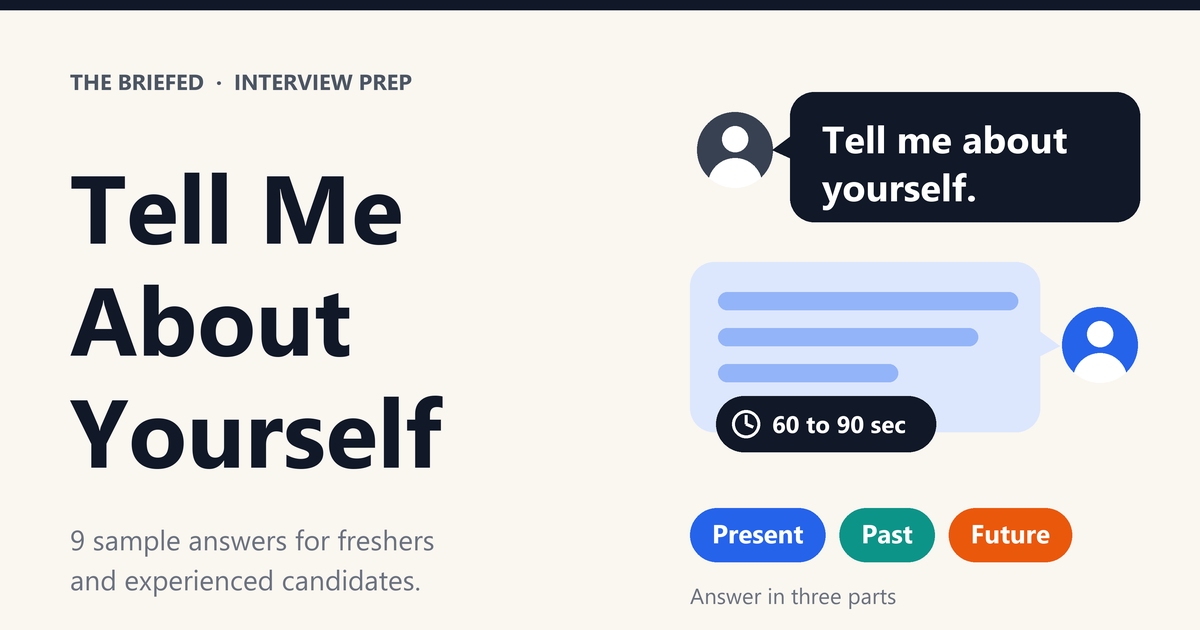
Answer "tell me about yourself" in 60 to 90 seconds. Say what you do now, name one or two things from your past that fit this job, and finish with why you want this role. Leave out your childhood, your school years and anything the interviewer cannot use to judge you for the job.
Almost every interview opens with this question, so it is worth practising. Below are nine sample answers (fresh graduate, experienced, career changer, remote, customer support and more), a simple structure for writing your own, and the mistakes that sink most answers. If you want to see what usually comes after this question, our list of 25 common interview questions and answers covers it.
What do interviewers want when they ask "tell me about yourself"?
The question sounds casual, but the interviewer is using it to decide where the next half hour goes. They want to know if you can talk about your own work clearly, whether you read the job description, and what they should ask you next.
A good answer gives them two or three things to follow up on. A weak one gives them a life story and no reason to be curious. It is also the first thing you say, so it sets your pace. If you ramble for four minutes, the interviewer has usually stopped listening by the time the real questions start.
How to answer "tell me about yourself": present, past, future
- Present: one sentence on what you do now, your job or your degree and year.
- Past: the one or two things from your history that matter most for this job. A project, an internship, a result. Use a number if you honestly have one.
- Future: one sentence on why you want this role at this company.
A fill-in template to start from:
I am a [job title or degree and year] at [company or university]. Recently I [your most relevant project or result]. I am looking for [type of role] because [one honest reason tied to this company].
Spend about half your time on the middle part. When you finish drafting, read each sentence and ask whether the interviewer could ask you a question about it. If not, it probably does not belong.
Spoken at a normal pace, 60 to 90 seconds is roughly 150 to 200 words. Time yourself. The guess is nearly always too long.
Tell me about yourself sample answers for freshers
These are samples. Swap in your own project, company and numbers, and never use a number you cannot explain if the interviewer asks "how did you measure that?"
1. Fresh graduate, software
I just finished my BS in Computer Science. For my final year project I built a web app that helps small shops track customer credit, using React and Node. About thirty shopkeepers near my university tried it, and I changed the layout twice after watching them use it. I also did a two-month internship at a software house in Lahore, where I fixed bugs on a Laravel project and learned how code review works. I am looking for a junior developer role where I keep working on a real product, and your team's work on the booking app is why I applied.
Why it works: the project is specific and it shows the candidate watched real users, which interviewers rarely hear from freshers.
2. Fresh graduate, business
I graduated this summer with a BBA in marketing. During my degree I ran the social media for our university society, and the event page went from about 400 followers to around 2,000 in one semester. I also interned for two months at a clothing brand, where I wrote captions and tracked which posts led to orders. I want to start in digital marketing because I like seeing results in numbers, and your agency's focus on small local brands is close to what I already did.
Why it works: it names a result and ties it to the agency's own work.
3. No work experience yet
I do not have a full-time job yet, so let me tell you what I have done instead. I finished my B.Com last year and took a three-month bookkeeping course. Since then I have kept the monthly accounts for my uncle's shop in Excel, including reconciling about 150 customer balances each month. I am careful with numbers and I finish things on time. I would like to start as a junior accounts assistant, and I can join immediately.
Why it works: it does not apologise for the gap. It replaces "no experience" with things the candidate actually did.
4. Customer support, first job
I completed my BA last year and since then I have worked part time at a courier company, handling calls and complaints for about five hours a day. I am comfortable on the phone, I stay calm when a customer is angry, and I am fine with night shifts. I want a full-time support role with proper training, and the US process you are hiring for fits what I want to learn.
Why it works: short, honest, and it answers the shift question before it is asked.
Sample answers for experienced candidates
5. Marketing, three years
I have spent three years in digital marketing, most recently as a marketing executive at an e-commerce company in Karachi. I manage Meta and Google ads with a monthly budget of around PKR 400,000, and over the last year I brought our cost per order down by about a quarter by cutting weak ad sets. Before that I did content and email at a small agency. I am looking for a role with a bigger budget and a small team to lead, which is why the senior executive position here interests me.
Why it works: the budget and the result tell the interviewer your level in two sentences.
6. Backend developer, four years
I am a backend developer with four years of experience, mostly Node.js and PostgreSQL. At my current company I rebuilt the order service, and checkout failures dropped by roughly half. I also mentor two junior developers. Earlier I worked on client projects at a software house in Islamabad, which taught me to work with requirements that change every week. Now I want a team that builds its own product instead of client work, and that is what your posting describes.
Why it works: it ends with a clear reason for leaving client work, with no complaint about the old employer.
7. Remote role
I have worked remotely for two years as a customer support specialist for a US software company, on a night shift from Karachi. I handle around forty tickets a day, mostly billing questions, and I write the help articles for problems that keep coming back. I am comfortable with Slack and Zendesk and with working without anyone watching. I want a longer-term remote position with a team that values documentation, and your posting mentions a knowledge base, which is my favourite part of the job.
Why it works: it proves the candidate can work alone, which is what remote employers worry about.
8. Returning after a career break
I worked as an HR assistant for three years until 2023, then took two years out to look after a family member. In that time I completed an online course in HR analytics and wrote CVs for about a dozen people as a freelancer. I am ready to return full time, and I am applying for HR executive roles because I already know the day-to-day work.
Why it works: it says what the gap was in one sentence and moves straight to what the candidate did during it.
Sample answers for career changers
9. Teacher moving into HR
I taught at a private school in Lahore for five years. The part I liked most was running the orientation for new teachers and sorting out timetable clashes. Last year I finished an HR certification and spent six months as a part-time recruitment coordinator, scheduling about twenty interviews a week. I am moving into HR full time because I enjoy the people side more than the classroom, and I bring five years of managing groups and deadlines.
Why it works: it explains the switch with evidence, then points out what carries over.
Common mistakes when answering "tell me about yourself"
- Reading out your CV. The interviewer has it in front of them. Tell them what the CV does not say.
- Starting with your childhood or school. Begin with what you do now.
- Talking about family at length. In Pakistan the interviewer may ask about your family as a separate question. Answer it briefly when it comes up, and keep it out of this answer. Our guide to interview questions in Pakistan covers how to handle it.
- Criticising your last employer. Even if it is true, it makes you sound hard to manage.
- Using adjectives with no proof. "I am hardworking and honest" tells them nothing. A fact does: "I kept the accounts for 150 customers without a missed month."
- Memorising a speech. It sounds like one. Know your three parts and say them in your own words.
How to tailor your answer to each job
Keep the same skeleton and change the middle. Read the job post and find the two skills it mentions most. Then pick the story from your past that matches them. The first and last sentences stay the same, and the middle changes for each interview.
It helps to have a 30-second version and a 90-second version. Use the short one if the interviewer seems rushed or starts with "quickly, tell me about yourself."
How to practise your answer
Record yourself on your phone and listen once. You will probably hear filler words and a flat voice the first time. Say it aloud five or six times over a few days. Do not memorise the exact words.
Check your CV matches what you say. If you are not sure, you can run it through our Resume and CV score review and you can also build new ATS Resume and CV . Then open the our job listings and find jobs that matches you skills by filtering jobs by country, roles, remote and onsite. Visit The Briefed to find out latest open roles worldwide.
Questions that usually come next
Interviewers often follow with "why should we hire you", and with "tell me about a time when..." questions. For those, the STAR method guide shows how to structure the answer. If you want every common question in one place, read our list of job interview questions and answers.
Comments · 0