Why Should We Hire You? 6 Sample Answers for Any Job
Pick one or two things the job needs, show you have already done something like them, and say what you would do first. Six sample answers for different situations.
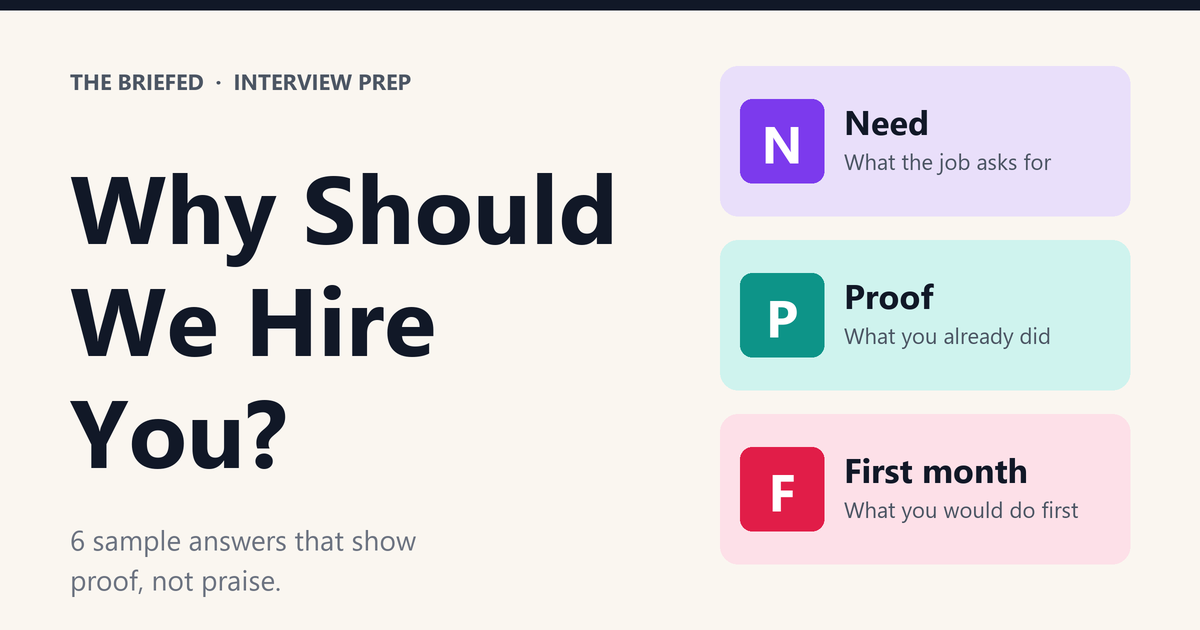
To answer "why should we hire you", pick one or two things the job needs, show that you have already done something like them, and say what you would do in your first few months. Keep it under a minute and leave out claims you cannot back up.
A common answer is a string of adjectives: hardworking, quick learner, team player. None of them can be checked. A short piece of proof can. This guide shows how to build that answer, gives six samples for different situations, and lists the lines that make interviewers stop listening. It sits alongside our full list of 25 common interview questions and answers.
What do interviewers want when they ask "why should we hire you"?
The question sounds like a challenge, but it is a practical one. The interviewer is asking what will happen if they say yes. Can you do the work, will you be motivated to do it here, and will you be easy to work with?
You do not need to beat other candidates, and you do not know who they are. You only need to make the match between you and this job easy to see. That is also why the same answer cannot be used in every interview.
How to answer "why should we hire you" in three steps
1. Pick the need. Read the job post and find the one or two things it stresses most. If it says "fast-paced" and "client communication", those are your two. 2. Show proof. For each need, give one thing you did that is similar. A project, an internship, a result. Keep it to a sentence or two. 3. Say what you would do. Finish with how you would use this in the first month or two. Many answers stop before this part. It is what makes the answer sound like a person who already works there.
Why should we hire you sample answers (6 examples)
These are samples. Replace the details with your own, and only keep numbers you could defend if asked.
1. Fresh graduate
I am at the start of my career, so there are things I will need to learn. But I already have a good base in Excel and reporting from my university work and a two-month internship, where I prepared the weekly sales sheet for a small distributor. I check my work twice and I ask when I am unsure instead of guessing. In the first month I would like to learn how your reports are built, so I can take over the weekly numbers from the senior analyst.
Why it works: it is honest about being new, and it names a specific first task.
2. Sales role, some experience
You are hiring someone who can open new accounts, and that is what I did for the last two years. At my current company I was given a list of cold leads in Gulberg and DHA and closed around eight clients in the first four months. I can start by calling your existing lead list and sharing what I learn from the first fifty conversations.
Why it works: it matches the job's main need and gives the interviewer something concrete to picture on day one.
3. Developer
Your job post says the team is moving from a single PHP app to separate services. I did that migration at my last company for our payments module, so I know where it usually goes wrong, mainly around database changes. I am not the most senior person you will meet, but I can start contributing to that move in the first few weeks, and I write tests as I go.
Why it works: it picks one line from the posting and answers it directly.
4. HR role
This role needs someone who can handle recruitment and onboarding together. In my last job I did both for a team of about 60 people. I scheduled the interviews, prepared the joining kit and followed up in the first week. I would start by reviewing how long your hiring takes now, then look for the slowest step.
Why it works: it names the job's two halves and suggests a simple first project.
5. Career changer
I know I do not have a marketing title yet. For the past year I have run the Instagram page for a friend's bakery in Karachi, and it now brings in a steady stream of orders. I learned to write captions, take decent product photos and read the insights. I would use that to help your small clients start posting regularly, which is the first thing your job post mentions.
Why it works: it faces the missing title, then shows real work that matches the job.
6. When you lack one requirement
The post asks for three years of experience, and I have two. In those two years I have handled the full month-end close on my own, which usually takes people longer to be given. I am quick to learn a new system, and I would use the first month to learn yours and take over the reconciliations from the current accountant.
Why it works: it does not dodge the gap. It names it and points to an equal strength.
What not to say when asked "why should we hire you"
- "I need this job." It may be true, but it is about you, not them.
- "I am better than the other candidates." You have not met them.
- "I am a hard worker and a quick learner." Without an example, these words are empty.
- "I will do anything." It sounds as if you have no preference, which can make you seem less committed.
- Reading from your CV. They already have it.
- Saying no to the question. "I don't know" or "you tell me" ends the conversation.
What to say if they reply "but you have no experience"
Stay calm and answer the doubt, not the person. Something like: "That is fair. What I have is [one real thing]. The part I would need to learn is [one specific thing], and I would spend my first two weeks on it." Interviewers are usually testing how you respond to a doubt, not trying to end the interview.
How to prepare in 20 minutes
Print or open the job post. Highlight the two things it repeats most. Next to each, write one thing you have done. Say the answer aloud twice. That is enough. If you want to practice a longer story with a result, the STAR method guide is the right tool.
Questions to practice next
Many interviewers ask this right after the introduction and before the "tell me about a time" questions. If your introduction is not ready yet, start with tell me about yourself sample answers. If you are interviewing in Pakistan, our guide to interview questions in Pakistan lists the questions local employers ask most often, and you can look for a role to apply to in the latest jobs in Pakistan.
Comments · 0